Translate

Monday, September 30, 2013

Terracina to Gaeta: time on the coast


 We have been enjoying the small cities on the sea as we cycle down the coast south of Rome.  Gaeta is so appealing that we have stayed an extra night.  The decision was easy to make because we are also staying in a particularly outstanding B&B.  We may be the last cyclists accepted here however, as the owners lost money when we fell upon the excellent breakfast.


We are staying high up in the old portion of the city, a maze of stairs and passage ways, many covered.  Close by is the bell tower of the cathedral, which has been beautifully restored.  It dates to the 10th century and is constructed in a style described as Arab-Norman.  The Moorish influence is quite clear.


Incongruous with this medieval setting, we awoke to the sound of the Star-Spangled Banner.  This is because Gaeta is the base for NATO (read U. S.) naval forces in the Mediterranean.  The music emanated from the American flagship Mount Whitney moored in the harbour.  Our host assures us that we will have the opportunity to hear the anthem again tomorrow morning at the same time.



Friday, September 27, 2013

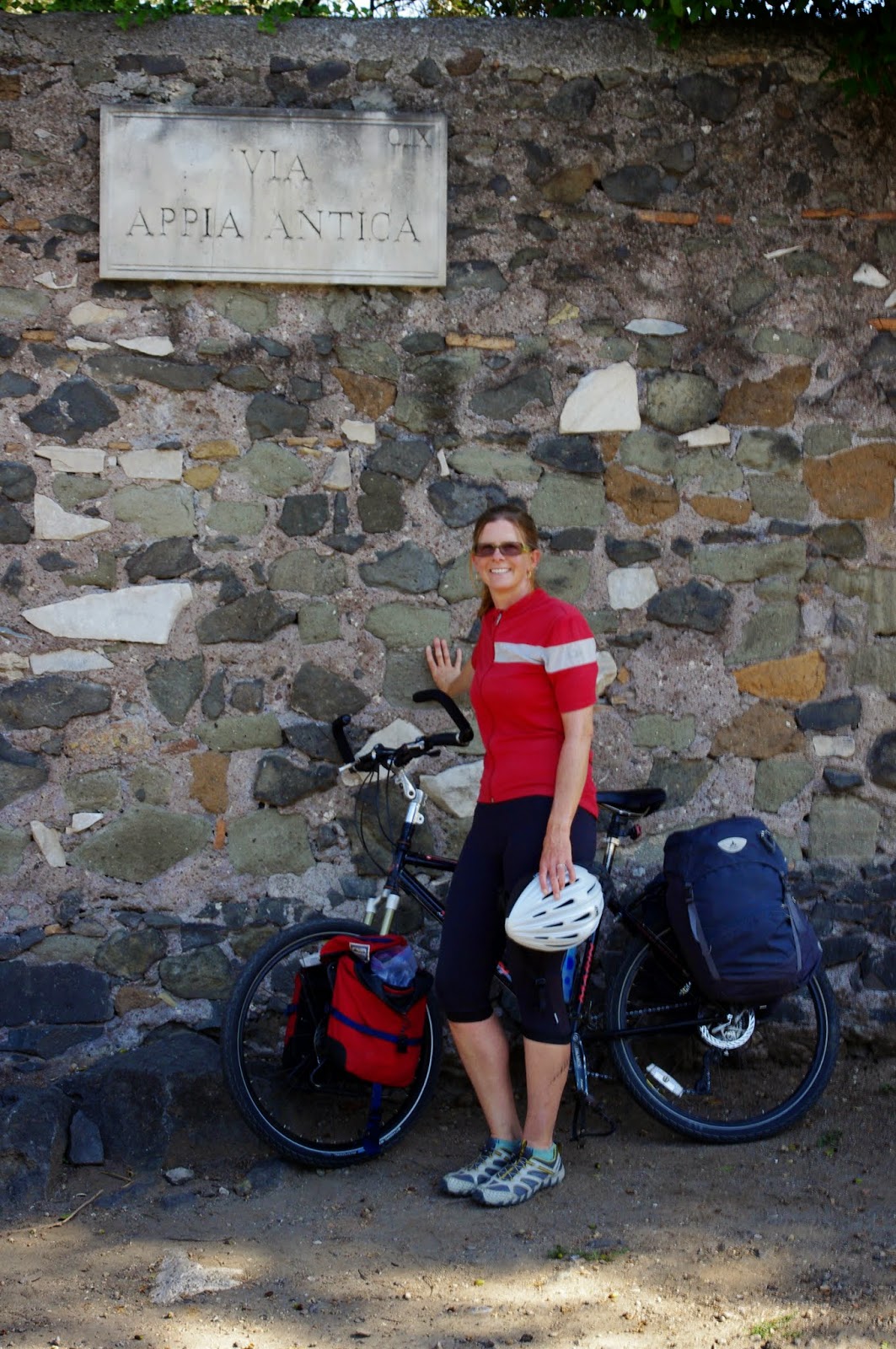
Still Pilgrims: Rome to Velletri on the Appian Way


We are pilgrims again! But first may I take a moment to apologize to all cyclists for my suggestion that to be a mere biker is somehow less worthy.  I have always held in high regard all people who move through the world on two self propelled wheels.  I also think smears of bike grease on the back of the calves when dining out are particularly sexy. 

For some crazy reason however, Gord and I just love being pilgrims. For us there is nothing better than finding an ancient route to follow. 


Yesterday we were casting about for a route for the next leg of our travels.  We dropped into a bookstore and found an Italian guide book for the Via Francigena Nel Sud. This is a 700 km continuation of the Via Francigena used by pilgrims to Jerusalem.  It largely follows the Appian Way from Rome to Brindisi.  We bought the book and and this morning headed out of Rome on the Appian Way, allegedly the first paved long distance road in the Western World. This road is just lined with Roman ruins and bits of history everywhere.  Some of the original flagstone paving remains.  It is very picturesque, but 2300 years of use have left their mark and the surface is essentially unrideable.  We contented ourselves with taking pictures and riding on a dirt track beside the Appian Way.


Our first pilgrim stop was at the Catacombs of Saint Callisto. Here we were treated to a fantastic tour of the first Christian cemetery, with tombs and frescoes dating back to the the early third century. I studied these early examples of Christian art in university so it was thrilling to see them first hand. Included in the tour was the earliest depiction of the cross as a Christian symbol. 

We get to be pilgrims now for another two weeks!


Wednesday, September 25, 2013

Saint Peter's Square: Lunch with the Pope.


Ruth:
Today we went to St. Peter's Square,  the final destination of the Via Francigena and the end of our 2800 km pilgrimage to 
to Rome. It's Wednesday, which means we were not alone. We joined at least 10,000 others keen on catching a glimpse of the Pope.


Wednesday is when he holds his weekly public audience. The adoring crowds treated him like a rock star. You could tell when the Pope was in our vicinity in the square because hundreds of cameras and iPads shot up into the air.

We were pleased to get our Testimoniums (the certificate granted for completing the pilgrimage). Contrary to what we had heard, they were easily obtained just outside St. Peter's square at the Opera Romana Pellegrinaggi, Piazza Pio XII no. 9. We will save our visit to St. Peter's and the Vatican museums for another day when the crowds are a bit lighter.

I will miss the identity of being a pilgrim and the special privileges  and unique community that comes with it. I remember feeling the same way when I finished my masters degree. It was one thing to be a grad student who worked part time, and quite another to be an over-educated, underemployed member of the plebs. I guess I am just a cyclist now. Still, a very, very fortunate one who has been permanently changed by the experiences of following an ancient pilgrimage route.


Tuesday, September 24, 2013

Cycling Into Rome from Sutri: Cyclists Fear Not the Road to Rome!


Cyclists have no fear there is a calm and beautiful way into Rome on Bicycle! 
Gord and made it from Innsbruck to Rome in just over 1800 kms!

If you are a cyclist on the Via Francigena, or just cycling into Rome from the North or East,  it is worth a few more kilometres and hills to go in on the Euro Velo 5.  Gord and I were both apprehensive about cycling into Rome, but we had a wonderful ride in that surprised us both. Here is my summary of our route in case someone else is looking for a calm way in. 


We started this morning in Fontevivola near Sutri. We headed NE on the SP82 and then quickly turned down the SP1 which merges into the Via Cassia or SR2. We stayed on the Via Casia just until Monterosi and took the exit for Campagnano.  The road climbs up to a ridge but it is worth the rewards of the long coast into the outskirts of Rome.  From Campagnano head for Sacrofano where you will join the Euro Velo 5. The climbing is over just after Sacrofano on the road to Prima Porta where the Euro Velo route takes you safely around the freeway and down to the river. The rest of the route simply follows the river into the heart of Rome.
Wonderful ride!

Enjoying the Trevi Fountain with 700 plus others.


Sunday, September 22, 2013

Tarquinia: A Pagan Side Trip to See the Etruscan Tombs


Gordon:  We left the Via Francigena for a couple of days to visit the UNESCO world heritage site at Tarquinia.  This was an important Etruscan city and it has received it's UNESCO designation for the tombs that they left.  What a treasure trove.  Hundreds of tombs have been found in the area, and many have wall frescos.

A number of the tombs can be visited in an open air museum at the edge of town.  From the road, the site appears to be a number of sheds scattered randomly over the landscape.  However, each of these sheds covers a staircase that goes several meters underground to a chamber cut from the soft stone.  The tombs date from the 7th to the 1st centuries B.C., and the frescos reflect the evolving ideas of the Etruscan afterlife during this period.  The art is reminiscent of Minoan paintings that we have seen, and it was a great pleasure to be able to see them.  The experience was enhanced by the fact that we were the only tourists on the site during our entire visit.


Thursday, September 19, 2013

Val D'Orcia: Hill Towns of Tuscany


 After leaving Sienna we have spent the last two days exploring the Val d' Orcia with its marvellous hill towns.
The valley was designated by UNESCO as a World Heritage site as "an exceptional reflection of the way the landscape was re-written in Renaissance times to reflect the ideals of good governance and to create an aesthetically pleasing picture. In other words it was a landscape manufactured for tourism. Since the Renaissance, it has been a popular subject for painters and travellers. And who are we to disagree. The hill towns in this area are charming and well worth the climb necessary to reach each one. We enjoyed the area so much that we slowed down and did some detours to visit more of the towns. This allowed us to also spend two nights with the same group of walking pilgrims. Now that we are getting closer to Rome there are about a dozen pilgrims at the hostels each night.

Rocca D' Orcia


Quirico D'Orcia


Tuesday, September 17, 2013

Siena: Rest and Repair


There has been a rivalry between Florence and Siena for hundreds of years and it continues today, with many tourists weighing in with strong feelings about their preference. Gord and I are not going to visit Florence on this trip, but we are very impressed with Siena. We have always leaned towards the Gothic over the Renaissance and Siena is a gothic gem.

 We are staying in a small apartment only two blocks away from Il Campo, the main square, and yet we are tucked away in a residential area without the tourist hoards a stones throw away.  It appears that the contrada in our area is Tower, as we have a meeting hall across the street that is dedicated to that group.  The city is divided into 17 contrada, which date back to the medieval period when they were involved in raising troops.  The contrade continue to dominate social life in the city, as we have been told that most important social rituals, such as marriages and baptisms, occur within one's contrada.  Competition between the contrade is played out each summer with two horse races around Il Campo.  These are not merely recreational events, but are of considerable importance to the contrade.  By the way, our guide states that Tower is the only contrada to have two enemy contrade, making it the most contentious contrada in the city.  No wonder our room was so reasonably priced: we're staying in a bad 'hood.

We spent our day exploring the Duomo and a number of museums located within the Cathedral area.  The Duomo not only houses exceptional paintings and sculptures by leading artists, including Bellini and Donatello, but also the most amazing inlaid stone floor.

  
Perhaps the best sight of all, however, was my new rack. The back rack on my bicycle had broken in a number of places and no amount of bondo, zap-straps and hose clamps were making it withstand the off road riding that we have been doing. I was so happy when we found a  repair shop that said they could set me up with a new rack that I did my happy dance right in the store, much to the amusement of the elderly lady manning the till.  Speaking of racks, my other set is now settling into a new smaller sized bra.  It seems that with all the fat on my body that I would happily sacrifice, I just lose in one area.