Translate

Saturday, March 24, 2018

Atlantis?


Ruth:
I am starting to believe that Flores Island is actually the lost world of Atlantis. It turns out that the world is not in itself lost, but the people who find themselves here run the risk of never returning to their homes. Take our host Neil, who came here with his wife twelve years ago for a short holiday. On a lark, they looked at a house that was for sale and the island's magical force began to tangle them in the ivy that would hold them here. Their house in Edinburgh was sold and roots were quickly grown in this little village. Stories like this are not uncommon. This morning we met a guy from Finland who claimed he had to get away from the Zoloft haze of Finland to finally discover unmedicated happiness here. No, he will not return, he firmly reported. Now his trilingual toddler is making new friends at the local grocery store/bar/meeting place. The owner of the grocery store speaks perfect English and describes her abandonment of the Bay Area in California to return here permanently. I can feel the pull myself as I Google real estate listings to see if there is a tempting house waiting for Gord and I. 


A view of Corvo, the smallest island in the Azores, population 400.


The current population of Flores is less than 5,000, down from more than twice that number 150 years ago. The smart ones either never left or returned. As a toothless local with a Boston accent said, "There's no money here, but I got cows, chickens, a lot of land and my pension."  When I asked the bar owner if he was from here, he said, "I'm from this island, from this town and from this house. I was born in this house."



Thursday, March 22, 2018

Terceira and on to Flores


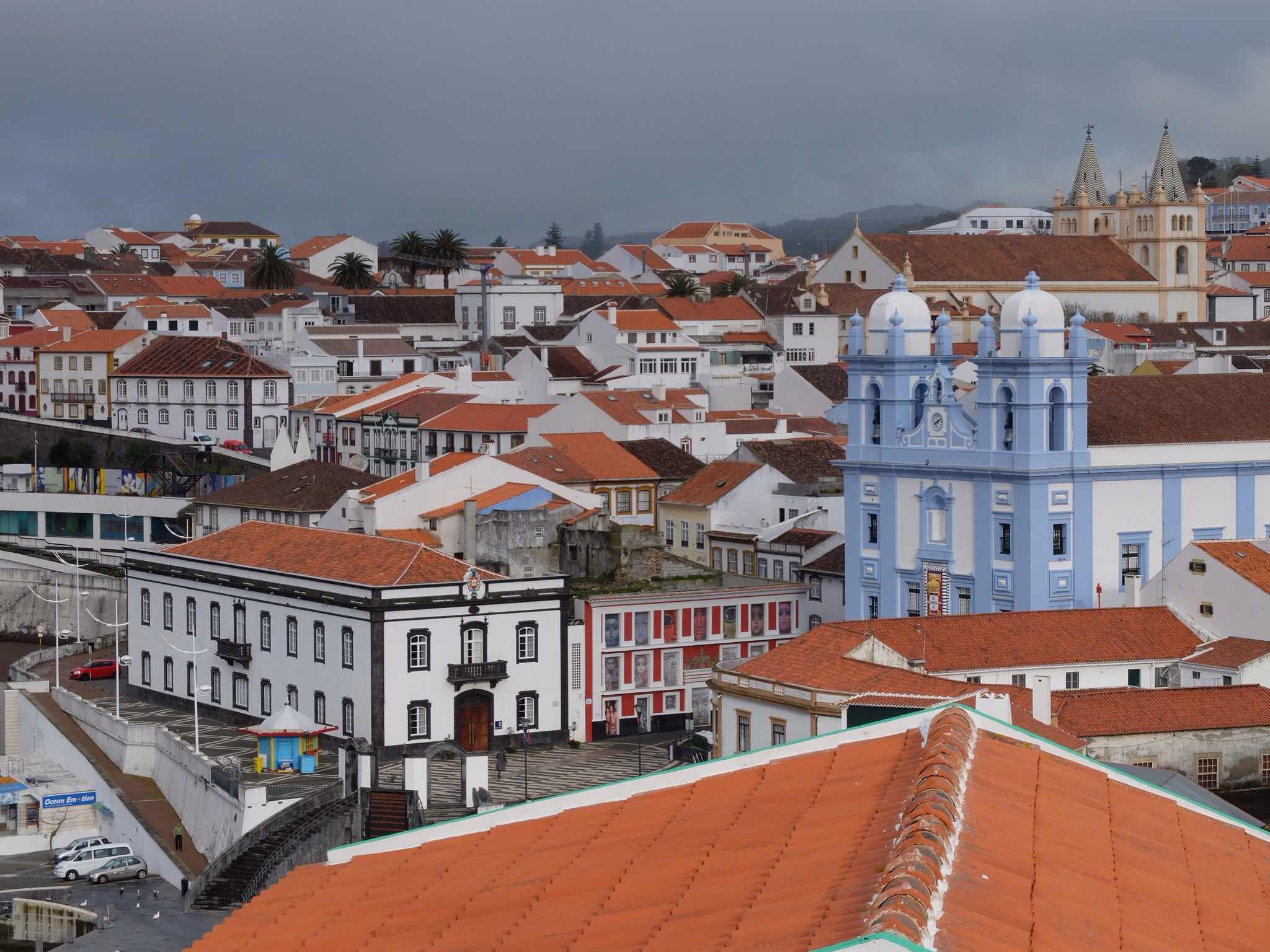
Ruth: We opted for a stopover on the island of Terceira so that we could visit the UNESCO listed port town of Angra do Heroismo.  It was an important staging point for the Spanish treasure fleets from the New World in the 16th century, when Portugal was under Spanish rule.  In a Canadian footnote, the Portuguese captain who discovered Newfoundland was an important figure in Angra in the late 15th century.  We got out for a walk in town as soon as the sun was up. It was well worth the stop. 


In the afternoon we returned to the airport to fly on to Flores. We are now at the Westernmost tip of Europe, unless you count Greenland. Flores has a population of 4,400 and receives about the same number of visitors in a year.  We expected it to be lush and beautiful, but we have landed in paradise. 


For the next four nights our home is a little stone house in the tiny village of  Fajā Grande.


Gord:  When Ruth was three years old she lived in England.  One of her most enduring and traumatic memories from that period was an encounter with a very threatening domestic goose.  Poor Ruth relived that experience yesterday on a road in Faja Grande.  While the goose was not head height, as it was when she three, it did rush at her repeatedly, hissing and with the clear intention of taking a nip.  As at three, I believe Ruth may have wet herself a little.  In the aftermath my lack of chivalry was the subject of some criticism, but in my defence, I had been immobilized by my own laughter.  Ruth recovered later with a glass of Moscatel on our patio.


Wednesday, March 21, 2018

Rocha da Relva


Gordon:  Today we went on another hike.  All of our walks have been quite different from each other, but all have been gorgeous.

This morning we walked down from a road west of Ponta Delgada to the tiny seaside community of Rocha da Relva.  The trail that we took to the village is the only access: there is no road and the boulder strewn coast is too rough to land a boat.  The beautifully crafted and mostly paved path works its way down the 500 foot lava cliffs, passing a few rustic houses and their tiny, terraced fields.  There are many grape vines, their branches trained a foot off the ground on numerous short supports.

The quaint village stretches along the sea for almost a kilometre.  It has an open air chapel and some seating facing the sea along the well-maintained trail.  Although this was no doubt a functioning village in the recent past, it was unclear to us whether it remains as such or is now only used seasonally.  We did see a few people, including a young man who was bringing supplies down with a pair of horses.  The stunning setting and access made us think of remote villages in Italy and Greece, before they became tourist attractions.  It remains a mystery to us that the Azores are not overrun with visitors.


Tuesday, March 20, 2018

Ruth's Day


Ruth: Yesterday's plan had Gord's name written all over it, with 18 kms of hiking and walking.  By the end of the day I was singing Leonard Cohen's lines, "I ache in the places I used to play."  This has become my theme song leading up to turning fifty next month. Gord, on the other hand, at sixty has the stamina I had at ... wait ... I never had his stamina. So today I needed a Ruth day. 


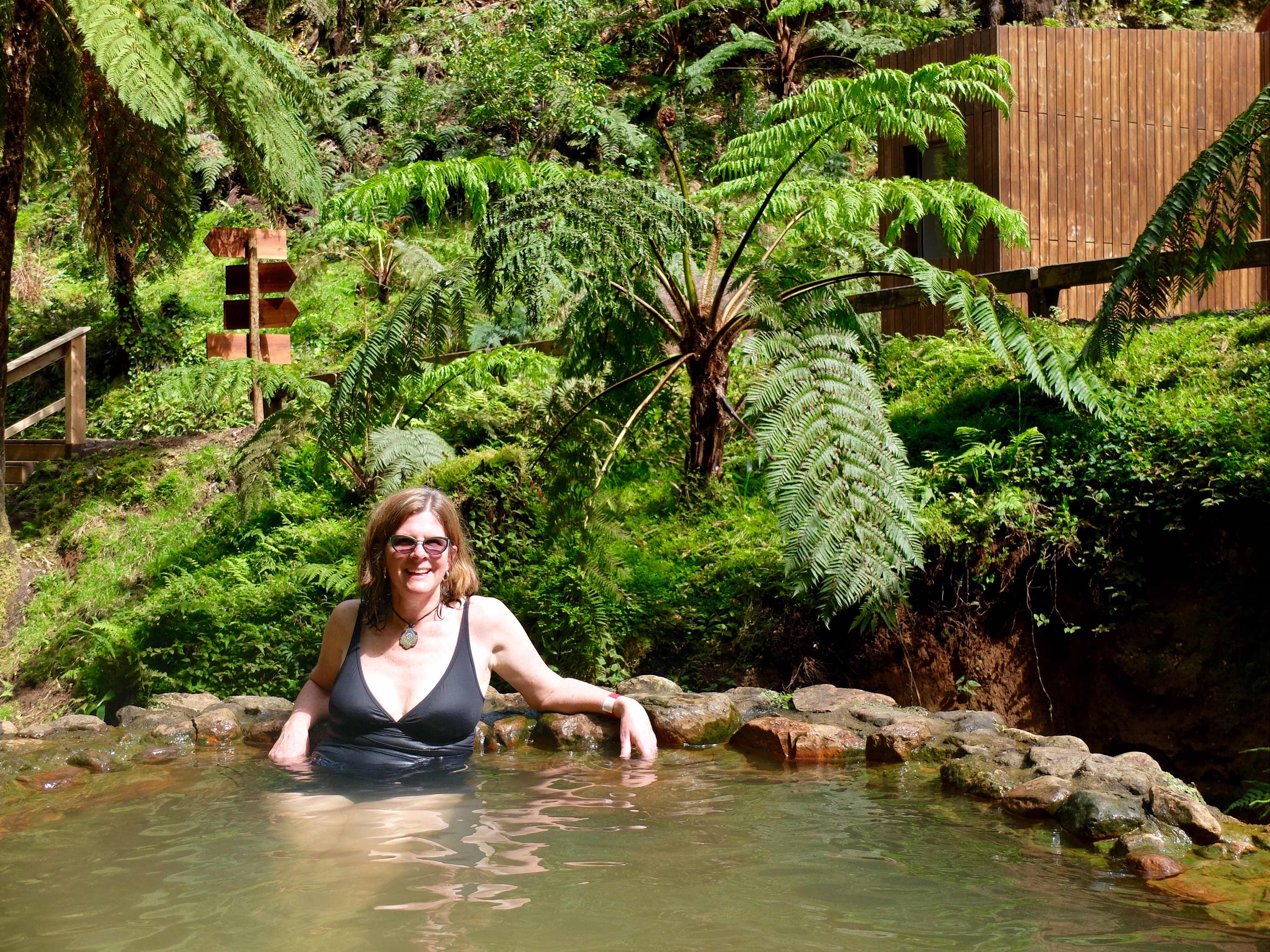
We started by driving up to CaldeiraVelha, one of the many hotsprings on the island. Ahhhhh, such a lovely soak with a chorus of frogs singing to us as we enjoyed the beautiful surroundings. 


We continued up the road to the edge of the caldera above Lagoa Fogo (Fire Lake) from where we hiked down to have a picnic at a beautiful beach on the lake.  It was a steep and difficult descent with my recovering body, but the pastel de nata, my favorite Portuguese treat, was a great reward. 


By the end of the day we still clocked ten kilometers. Gord was able to tolerate this more reasonable mileage because I sent him out for an eight kilometer morning run. 

Monday, March 19, 2018

Sete Cidades


Gordon:  What if there was a place like Hawaii, but a few degrees cooler, so that hiking is more comfortable, only a few tourists, and, say, at a third of the cost?  If that sounds like a good destination, may I suggest the Azores?

We went on our first hike today, in the popular Sete Cidades area.  This is a large volcanic crater enclosing two lakes, one green and the other blue.  The crater also contains the town of Sete Cidades (“Seven Cities” - I don’t know the origin of this as there is only one small town in there) and some agricultural land.  


We approached Sete Cidades along a portion of the crater rim on a dirt road only just wider than the car (a Toyota Ayga, which I believe translates as “go-cart”).  There was a dense fog, which was just as well, as it prevented us from seeing the 500 foot drop on either side of the road.  A highways crew was working on the road, which included planting a hydrangea hedgerow on either side.  This was done simply by cutting hydrangea canes in 50 cm lengths and jamming them in the ground.  Conditions are so conducive to growth that the canes are already sprouting leaves.


Later, at the bottom of the crater, we walked around the smaller lake, Lagoa Verde.  The forest was lush, with native trees that reminded us of cedars, but undergrowth that was more reminiscent of the tropics. The air was filled with birdsong and scents that recalled Hawaii.


On our return drive, on a larger, paved road, we encountered a number of tourist vans and buses.  The sudden appearance of so many tourists was explained when we returned to Ponta Delgada and found an enormous cruise ship in the harbour.  Our apartment is half a block from the waterfront on a narrow street perpendicular to it.  The view down the street is now dominated by the bow of the cruise ship.  I understand that cruise ship visits, particularly now, in low season, are eagerly anticipated as they provide a significant stimulus to the local economy.


Sunday, March 18, 2018

First Day in Ponta Delgata


Ruth:  With jetlag my writing and thinking skills are absent but I will try to capure our day.
During a 6 hour delay in Toronto while our pilot got his beauty rest, we tried to walk and nap at the airport until our flight left at 3:00 am. SATA only has one plane on this route and if they arrive late, as happened with the previous day's flight, the crew's required rest time has to be added in for safety reasons. An annoyance, but I am willing to admit it might be a wise decision. 

On our drive in from the airport I could easily recognize the buildings I drew of the town before our departure. It is a fun way to discover a place. The vegetation here is lush and exotic, nurtured by the gentle climate.  The town of Ponta Delgada is charming and very recognizably Portuguese.

We spent an hour in a local museum with its creepy collection of all things taxidermied, including three two-headed (Siamese) calves and a small domestic spaniel.


Ok my brain has cats on its mind. Its Ponta Delgada ( Handsom point) instead of  Ponta Delgata ( Point of the female cat). 
Time to sleep. 

Saturday, March 17, 2018

Heading off to the Azores


Ruth:
In my usual pre trip excitement I started drawing the anticipated sights days before our departure. Don will take us to the airport shortly and we will officially be on route. We will land in Ponta Delgada on Sao Miguel around 12:30 AM Victoria time.